Remembering and imagining a path toward justice
on keep-goingness and finding our way more deeply into this struggle, plus notes from the Donald J Trump and Jeffrey Epstein Memorial Reading Room


Art by Adam D. Thompson, for the New Yorker on Instagram
Greetings Resisters!
We write to you at the end of yet another topsy-turvy, upside-down week. Just when we thought the corruption couldn’t get any worse (okay, we did think it could get worse, but not quite like this), Trump’s DOJ has proposed allocating 1.776 billion dollars for Trump cronies, including the white supremacists who stormed the capitol and killed law enforcement members. The saying “for my friends, everything, for my enemies the law” while accurate, doesn’t begin to get at the grotesqueness of the move.
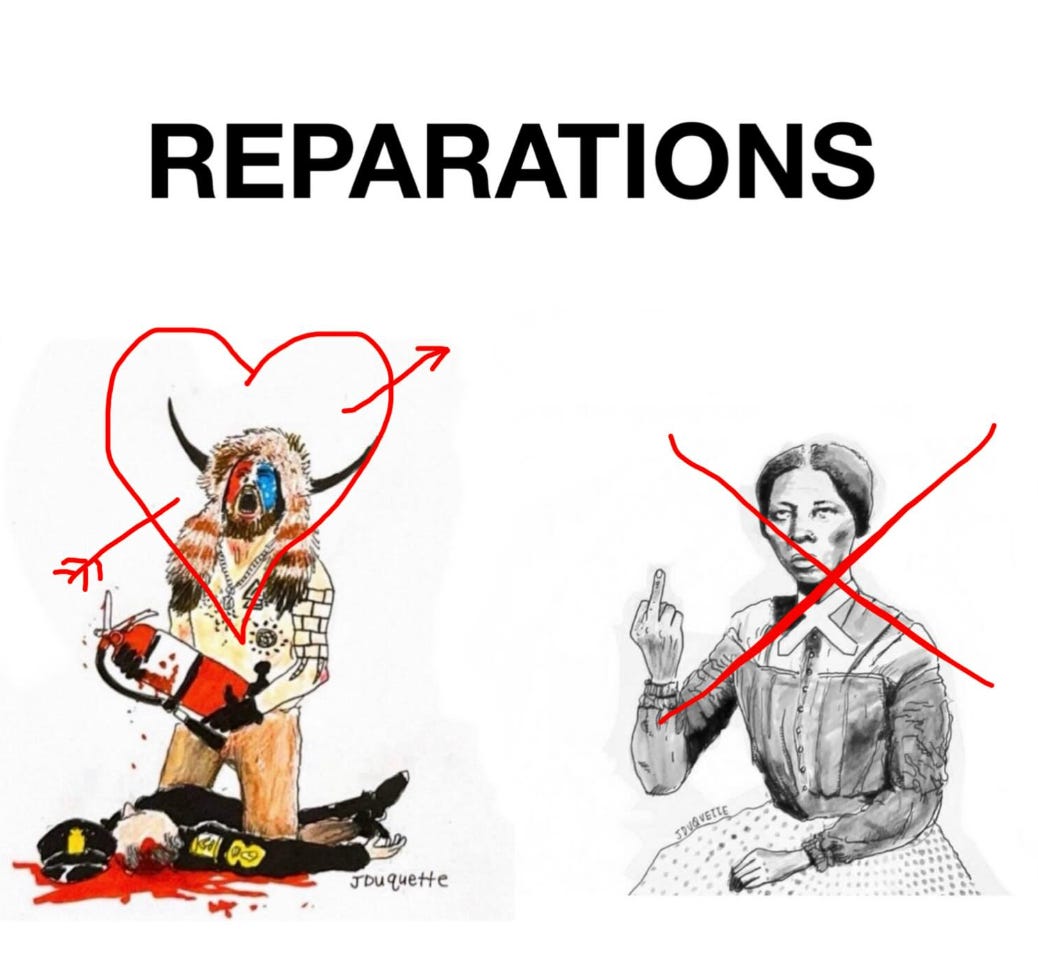
Image Credit:@misterjesseduqette on Instagram
The primary elections held Tuesday offered a few glimmers of hope, with progressive wins like the election of Chris Rabb in PA-3, along with some sobering realities as Trump picks overwhelmingly won on the Republican side. Meanwhile, we are left to wonder what all this means for the midterms, including what the flagrant disregard for the rule of law by the sitting president portends for their integrity. As we’ve been noting, it’s easy to get discouraged, but so many of us are finding strength and resilience in a variety of beautiful yet imperfect ways. Today we bring you a meditation from Joelle Berman, queen organizer and movement whisperer, on what’s getting her through these days.
Why I Stay In This Fight
By Joelle Asaro Berman
In our world’s constant storm of demoralization and collapse, it’s easy for me to get numb to the daily (nay, hourly) flow of bad news. When the news came about the Voting Rights Act and how quickly state legislatures across the South moved to further disempower Black voters – and all of us – as a result, it pierced my numbness, and forced a pause.
In the pause, I revisited a core question: What keeps me in this fight?
Whatever answers I can muster in moments like this are thanks to what I’ve learned along my political journey from movement elders, Black feminist futurists, Jewish Labor Bundists (more on them below), and Indigenous healers: that this work that we are doing together is about something so much bigger than the midterms, or fighting fascism, or even saving democracy. It’s a fight for our humanity and all life and the freedom that can only come from being in real relationship with one another.
Image Credit: @fabfeminstart
Another way of saying this is that we do all of this fighting and mobilizing and activism and keep-goingness not because we are guaranteed a win; indeed, the losses are coming and there will be so many more of them before we’re through. Instead, we show up because we are in a cross-generational struggle, building on the work of so many who came before us who had way fewer rights or reasons to believe they would win (let alone survive), but who kept at it anyway.
Maybe you know some of these fighters. Maybe they are your ancestors, your grandparents, your parents. Maybe they’re your teachers, people who have organized you, people you studied. Maybe you simply feel a kinship with them across time.
These days, I’m finding a particular comradeship with members of the Jewish Labor Bund – a secular, socialist, and deeply influential Jewish political force in eastern Europe in the late 19th and early 20th century – and whose story is captured profoundly by Molly Crabapple in her new book, Here Where We Live is Our Country. In the introduction, she offers: “Despite vast differences in the worlds that we inhabited, Bundists seemed to me like kin. Like them, I knew the floor of a police cell, the boredom of a leftist meeting, the electric charge of passing a pamphlet to a stranger, the high of believing, rightly or wrongly, that you are about to change the world.”
My fellow Resisters, if we collectively know nothing else, is it not the electric charge of handing a zine that our very own members have crafted and folded with love to a stranger, in the hopes that they will find their way more deeply into this struggle?
So I will keep folding and handing out zines; I will keep meeting up with you for one-on-ones; I will keep gathering us to build this political home; I will keep raising money; I will keep turning us out for marches, and on, and on. Because I sure as hell am not letting down all these badasses who came before me, nor am I letting down the people who will surely continue this work after we are gone.
Image Credit: @fabfeministart
Here is what I know: I have come to trust and love and believe in the people I’ve met through Brooklyn Resisters in ways that patriarchy, capitalism, antisemitism, and any number of powerful forces never would have wanted me to or dreamed I could. For me, this means that in some sense, we’ve already won, because we’ve already built what we have – and this doesn’t mean we get to walk away. It means we keep organizing and keep building and keep deepening our connections with one another so that more of us can be in the struggle as wholly and humanly as we have been thus far, and could yet be.
There’s so much they can never take away from us. Our tethers to generations past and future– to loved ones and strangers–our connections and relationships and our love and our care between one another is the Whole. Damn. Point.
I leave you with this wisdom from organizer and writer Derecka Purnell:
This isn’t a popular thing to say, but I don’t know if we will win.
I also don’t think I care.
People who ran away from slave plantations didn’t know if they were going to get free,
But they ran anyway
I want people in my life who choose to run away,
I want to be surrounded by people who resist anyway.
Freedom is bound in struggle. And in running
Not winning and losing. Freedom happens in our souls.
Before we can speak it in a song, chant, or a hashtag.
Freedom is a decision,
Not just an outcome.
Select Bibliography:
Loretta Ross: “Don’t Let the Chain of Freedom Break at Your Link”
Everything for Everyone by M. E. O’Brien and Eman Abdelhadi
Here Where We Live is Our Country by Molly Crabapple
Braiding Sweetgrass by Robin Wall Kimmerer
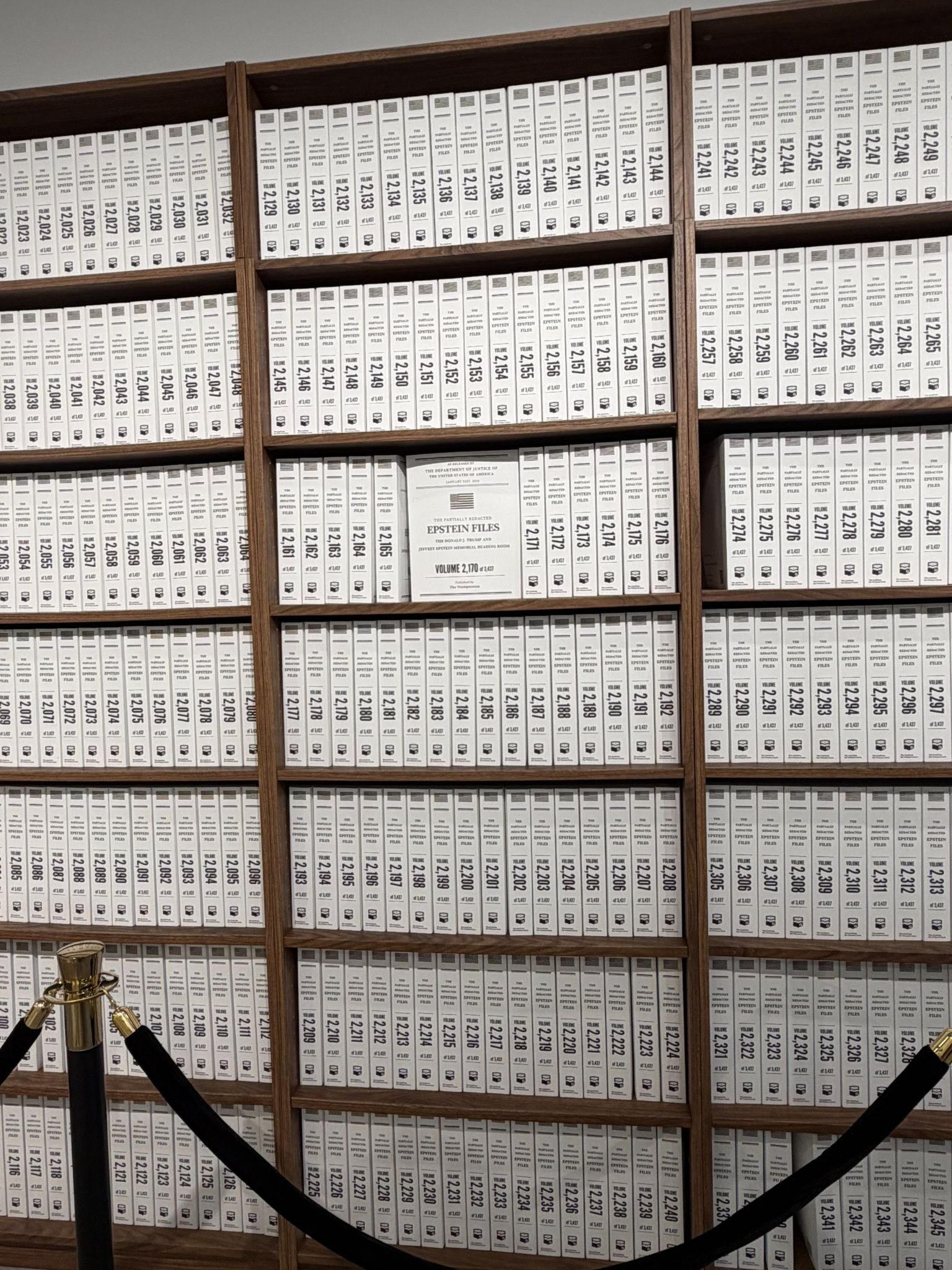
Volumes of Epstein file documents inside the Trump and Epstein Memorial Reading Room. Photo credit: Julie Subrin.
Notes from the Donald J Trump and Jeffrey Epstein Memorial Reading Room
By Julie Subrin
Earlier this week, a few of us took a field trip to The Donald J. Trump and Jeffrey Epstein Memorial Reading Room. Of course, there is no such reading room in the “real” world. This is an art installation created by the Institute for Primary Facts and housed in a gallery in lower Manhattan. (It will remain up through Sunday, May 24. Entry is free, but online reservations are recommended.)
The Reading Room spans two floors. On the upper level, the walls are lined with floor-to ceiling shelves containing printouts of the complete Epstein files—3.5 million pages, in 3,437 bound volumes. Towards the back, a timeline tracks Trump’s predations (gropings, violent assaults, etc), Epstein’s sexual and trafficking crimes, and the decades-spanning friendship between the two men. At the center of the room, in a curtained area, is a memorial with hundreds of candles to honor the survivors.
It’s a lot to take in, and honestly left me somewhat numb, in part because in this reading room you can’t actually read the files. They are off-limits out of respect for the survivors, because the DOJ, while assiduously redacting the names of most of the powerful men in the documents, left many of the victims’ names unredacted, along with other highly sensitive information and even photos. (For a full accounting of how our justice system has failed these women over and over, listen to this. Warning: It is utterly rage-inducing.)
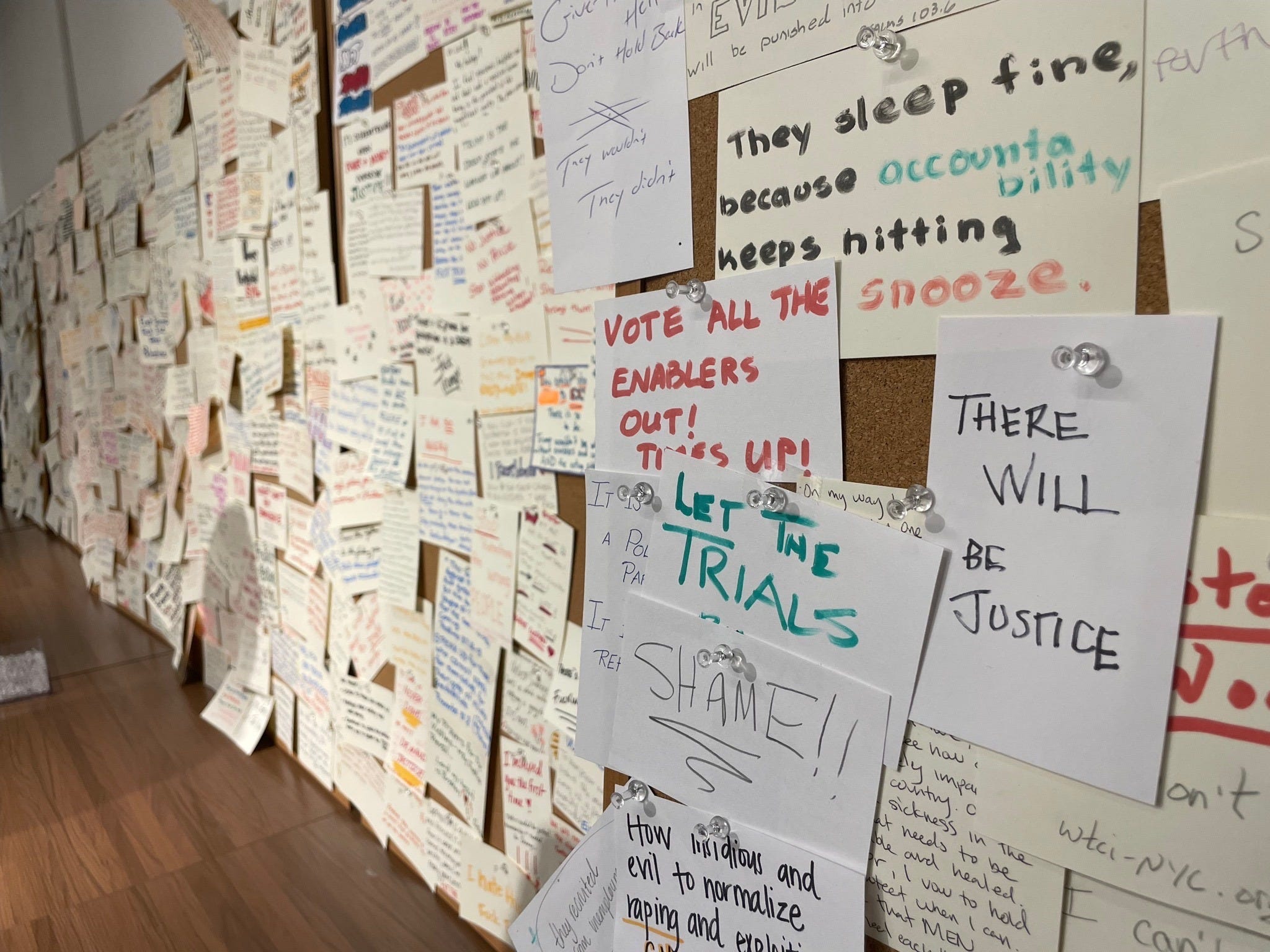
Bulletin board, lower level, Memorial Reading Room. Photo credit: Léa Zimmerman.
More powerful, for me, was the display on the lower level. There, you’ll find bulletin boards crammed with handwritten notecards from visitors. The language people choose is often simple, but their grief and fury is palpable. (One, pictured below, reads: “For my 3 sons - - I’m sorry your generation inherits this. Please help burn it all down + build something better. [heart] Mom.” Clearly, the crimes contained within the files touch a nerve—not only in and of themselves, but also insofar as they reflect a society that so often protects abusers. The cumulative effect of these individual messages, this collective outcry, is a visceral reminder that we, the people, are not ok. We are trying to heal wounds so much bigger than any one of us. At the same time, this room full of pain and anger is a powerful reminder that we are not alone.
Below are a few snapshots we took from our visit.
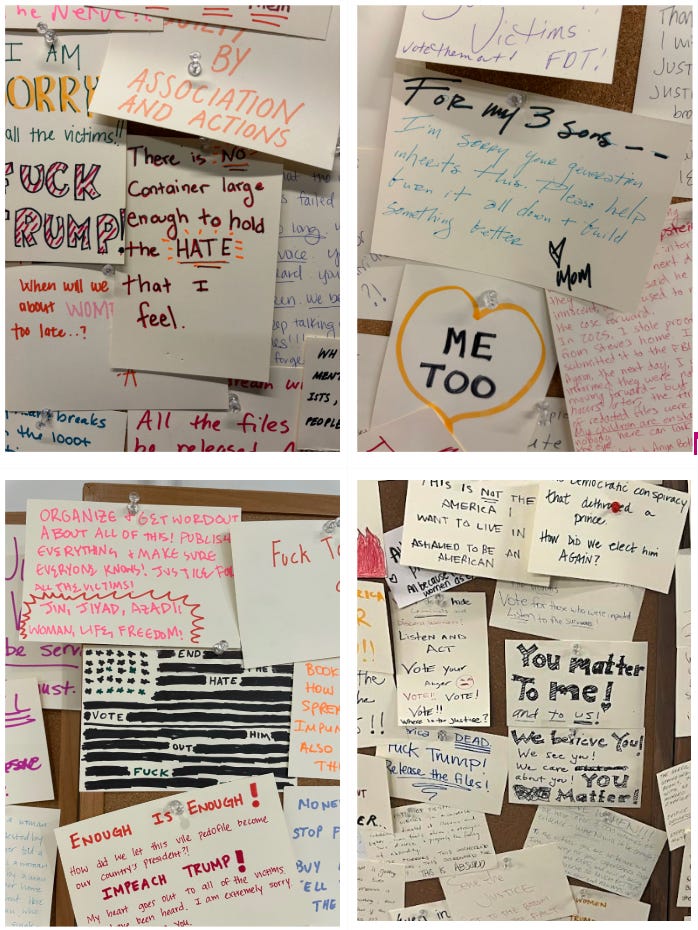
Details of the bulletin board on the lower level. Photo credit: Léa Zimmerman, Jenny Wood and Julie Subrin.
Amplify this
Trump “Anti-Weaponization” Slush Fund FAQ, care of The Daily Show
Thank you Colbert, we needed this joy right now
No but really, let’s talk reparations
Trump’s Insurrectionist Payout Scheme Violates the 14th Amendment by Sherilyn Iffill
The winner of the Kentucky GOP primary
Use this form from Advocates for Trans Equality to urge your Senators to vote no on PSLF and protect public service employees, including those providing gender-affirming care. (h/t Eitan)
Head to Bryant Park June 1 for a reading party (h/t Jenny)
1,000 World Cup tickets. $50 each. All for New Yorkers.
Come canvass for Brad Lander with us next Sunday!
And as always,
‘Til Next Time,
Julie, Kate, & the Messaging Team
 | A guest post by
|
 | A guest post by
|