Messaging Roundup: One Year Later
Well, we made it to a year writing this thing. And as usual, we've got some thoughts.


Messaging Roundup: One Year Later
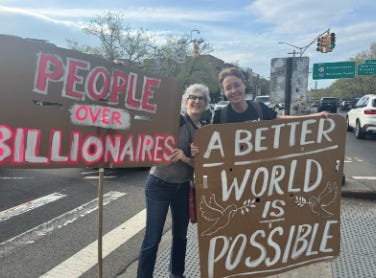
The Messaging Team holding signs like we mean it
Hi Resisters,
For months now, we’ve understood that there are three hallmark traits of this administration: chaos, corruption, and cruelty. Now, those traits have been unleashed on a global scale, and the cost is almost too great to comprehend: billions of dollars spent (an estimated 11.6 billion as of Thursday) that should have been spent on improving and saving lives here at home, hundreds of civilian deaths across the region, and what Bill McKibben has referred to as “ecocide,” as oil refineries and tankers send plumes of black smoke into the sky. And we still don’t know where this war is going, and what the ripple effects will be, which is frightening for all of us. There are important messages to convey to our congress people and to anyone else who will listen, and actions to take regarding this crisis.
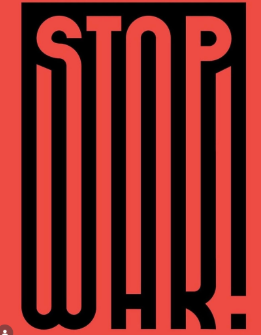
Image Credit: @carlawelchstylist on Instagram
This week, though, we are going to do a bit of a retrospective that we hope will be uplifting, or at least fortifying, as we continue this fight for a better future. We are celebrating a milestone! A year ago, on March 12, we met for the first time. Saul had connected us after we’d each expressed an interest in messaging work. One coffee brainstorming session later and we were on our way to creating a messaging Signal chat, as well as a newsletter that we ambitiously set to release weekly. Our first edition dropped on March 21.
Everything is on fire,
but everyone I love is doing beautiful things
and trying to make life worth living,
and I know I don’t have to believe in everything,
but I believe in that.
We did not know each other before this work, though it is pretty common for people to think that we did. And we’re different in many ways, generationally and otherwise. Yet every week we write this thing together, remarkably in sync, making each other laugh and holding each other steady along the way, even (or especially) when things are pretty damn terrible. With all this in mind, we thought it might be interesting to take stock of where we’ve been and honor the collective work we’ve all been doing together over this time. We’ve said it before, but one of our favorite things about doing the newsletter is writing for this audience. We are so grateful to be in this fight with you.
Why did we start this?
Julie: I’ve always been interested in trying to understand other people, and to make myself understood. (Maybe it’s a middle child thing.) But I don’t think that felt politically urgent to me until we faced the losses of the 2024 election, despite the many hours so many of us had spent talking to people about the stakes.
What really spurred me was a conversation I had on Election Day. That morning, I was running late to a final, local GOTV door-knocking shift, and decided to take a Lyft. My driver was an easy-going guy in his early 20s, who’d grown up nearby in Little Pakistan with immigrant parents. During the ride over, I asked him who he was hoping would win that day. He told me he didn’t really follow politics, but that his friends said they would never vote for a woman, because women are too emotional. Also according to his friends, Trump would make a better president, and be better for the economy, because he was a successful businessman. Any counterarguments I made landed without impact.
As we talked some more, it became clear that he wasn’t remotely concerned about the threat of an authoritarian takeover that I and so many others had been losing sleep over for months. I knew he was wrong about so many things, but my facts were no match for the right wing messaging he and his friends had adopted wholesale (and that clearly, at some level, spoke to their experience).
That night, after the results came in, I realized that that guy had told me pretty much everything I needed to know about how this election would play out. Those results, and that conversation, left me desperate to understand what stories, what words, what strategies might have a fighting chance of breaking through people’s apathy or understandable lack of faith in government’s ability to make our lives better. I think my sense of purpose has shifted since then, but that’s what led me to tell Saul I was looking to meet with others interested in messaging.
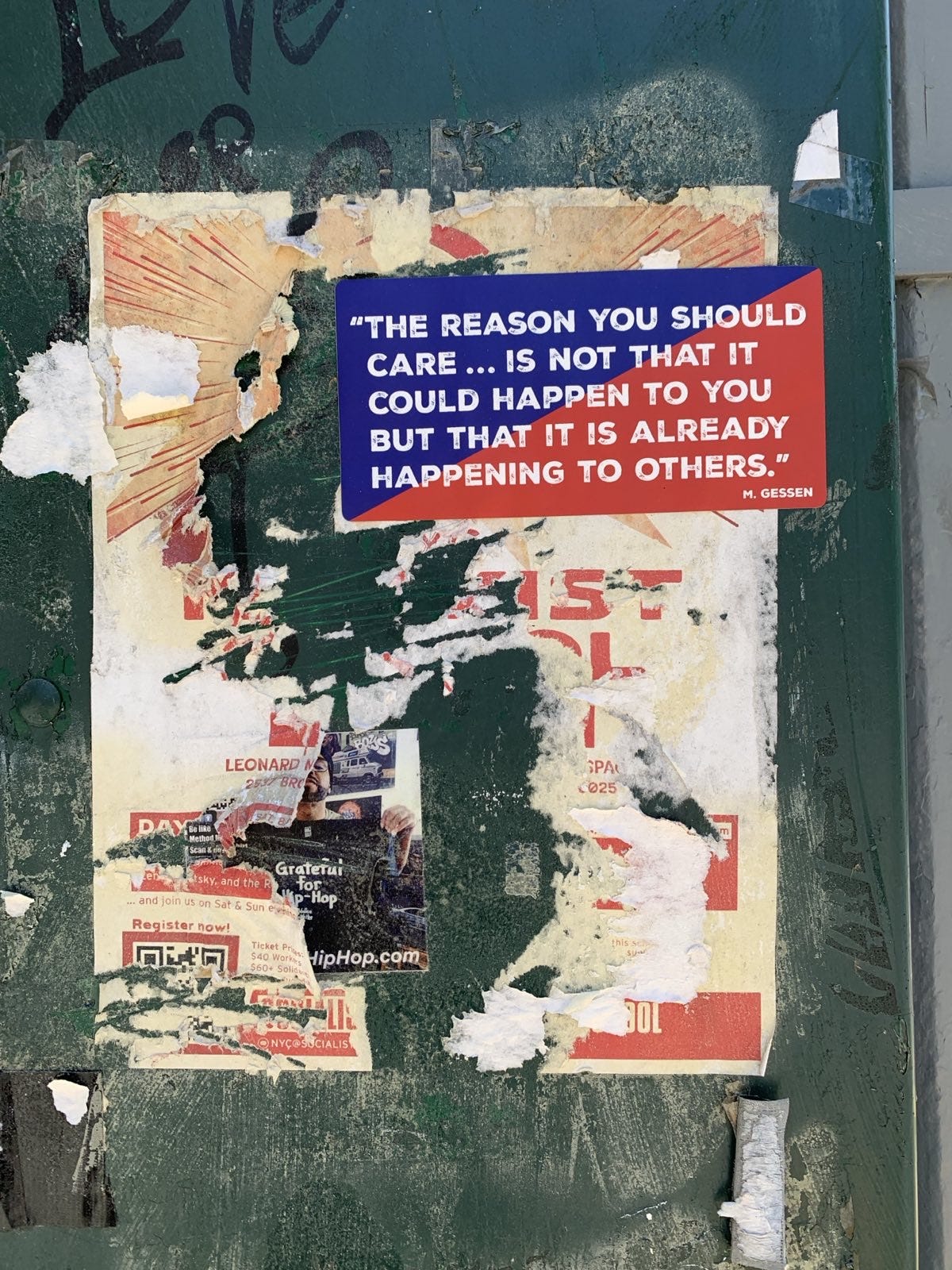
Seen on the street. Quote from M. Gessen.
Kate: I spent Trump 1.0 on a media literacy project, Mucktracker, that grew out of the Get Organized Brooklyn Free Press group. Specifically, my co-founders and I built technology to help students analyze and evaluate reporting and larger media narratives. Over the course of our work, I came to discover leading thinkers and researchers in the field, who pushed me to consider both the limits of technology and so-called fact-based approaches to misinformation, which often overlooked the affective and emotional dimensions that shape our ideas and beliefs.
When Trump 2.0 hit, I, like Julie, was obsessed with messaging and was eager to apply my knowledge and experiences from Mucktracker to shaping hearts and minds, but instead of focusing on technology, I returned to another kind of tool near and dear to me: language. I was frustrated with the post-election discourse, with takes that blamed advocacy for trans rights, or eschewed any analysis of race or gender, even in connection to perceptions of economic strength. I was also closely following misinformation researcher Kate Starbird who advocated that the left needed to get better at telling its own story, along with scholar Ruha Benjamin who challenged us to “imagine and craft the worlds you cannot live without, just as you dismantle the ones you cannot live within.” I wanted to do something impactful to confront the horror we were all facing, but I had no idea what shape that would take, nor that I would have such a trusty, ethical, and easygoing yet determined partner who would be game to try to make sense of it all with me.
Some reflections on a year of roundups
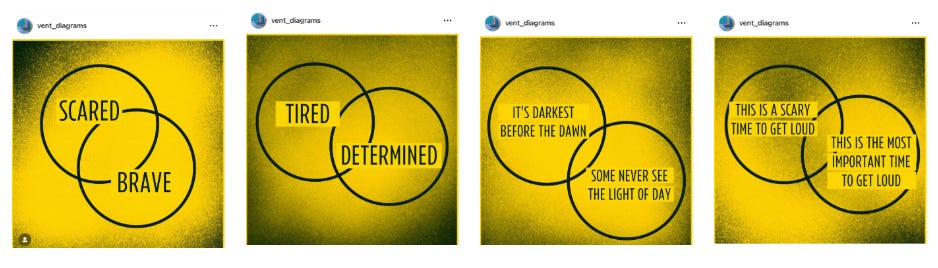
from 4.18 Resisters Messaging Roundup: Kilmar Abrego Garcia, due process, & us, Image Credit @vent_diagrams on Instagram
Kate: Going back to the early days of this regime, I can’t help but remember how quiet the resistance seemed and how that made writing this newsletter feel a little subversive, and needed. Though we know the chorus of ordinary citizens against all this has grown louder, there have been some harrowing moments. The murder of Charlie Kirk for instance seemed to lead to a sort of chill. The rhetoric of the left, of people like us, was being blamed for his murder. Jimmy Kimmel of all people was for a moment taken off the air. What did that mean for the rest of us? Then there were the murders of Renee Good and Alex Pretti, which hit all too close to home. I remember thinking it was a miracle we could put out anything at all. But finding words to make sense of all the feelings we (and others) were having felt important, and necessary.
In terms of content, we have been pretty consistent on a few fronts. For one, we’ve emphasized the need to tell a different story about who we are as people. We’ve emphasized messages of interdependence and the value of collective care. Initially, we were countering the DOGE bro narrative as they gutted budgets under the guise of “efficiency” but in reality were inflicting cruelty and harm. Then, we were telling stories pushing back against the harm of other forms of authoritarian overreach, including ICE abductions and foreign wars.
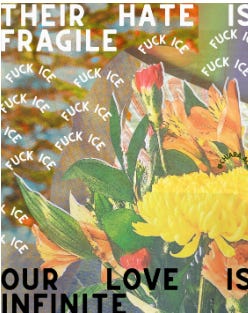
Image Credit: chiara francesca galimberti @chiara.acu
How we frame our counternarratives has varied. Sometimes, we’ve spotlighted stories of resistance, whether that was civil rights leaders, or the heroic efforts of DC, LA, and Minneapolis. Also, thanks to Julie’s nudging, we began more and more to tell our own stories. It was especially meaningful for me to write about how being a guide for athletes with disabilities informs my activism work, and how in class with my students, reading Cornelius Eady’s poem, “Proof” from Mamdani’s inauguration, provided a moment of great hope and inspiration. As I was writing these pieces, I kept the disability justice saying “Nothing about us without us” in mind and was grateful that James, the athlete I guide, and my students were involved during the writing process. This newsletter has always been a collaborative venture, and it is always gratifying to see this aspect evolve and grow along with us.
Julie: In the beginning, we were pretty focused on messaging, narrowly defined. Our very first one began, “Here’s a round-up of some of the best messaging and messaging ideas we came across this past week.” We shared advice on word choice, on framing, on what not to say, following the lead of messaging gurus like Anat Shenker-Osorio and Antonia Scatton.
Now, some of those early editions look almost quaint. These days, I think we are less concerned with debating questions like “what term should we use to refer to this administration” and more with how to slow or stop its harmful actions. I think we’ve come to see our task as twofold: first, giving voice to our collective grief, horror, anger, love, hope, and determination as we cycle through those states. And second, trying to break through the lies, obfuscation and false framings that we see coming from our leaders and from mainstream media, and to share alternative ways of understanding that are grounded in truth, in our lived experience, and in moral clarity.
Looking through this archive, I’m also struck by the way it serves as a kind of time capsule for all that we’ve been through collectively these past 12 months—as a group, a city, a country. The horrors and triumphs of the past year are something of a blur for me, but here you can see them all laid out, week by week, along with our attempts to make meaning of them.
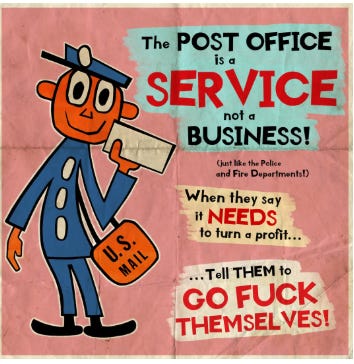
From 3.28 Round-Up: Word Association, ChatGOP, and more
When we began, Mahmoud Khalil had only recently been abducted. D.O.G.E. was our primary focus. Then we had the disappearance of Kilmar Abrego Garcia and hundreds of others to a megaprison in El Salvador. There was the local campaign against Cuomo, and nationally, against the MAGA Murder Budget. Fast forward to Mamdani’s stunning victory, and then ever-escalating I.C.E. sieges in blue cities across the country. Now it’s Epstein, and war, that is consuming us. Also chronicled in this archive is our ever-growing capacity as a group to respond in more and more creative and urgent ways to these threats.
Last but not least, I’m struck by the depth and longevity of this undertaking. I had no idea what we were getting ourselves into when Kate first suggested “maybe we should do some sort of newsletter”! Somehow, and with the help of every guest writer and “Amplify” Signal chat contributor, we have created something that reflects our values, and that we hope invites people to resist the chaos, and to find meaning, purpose and paths to resistance, or at least to feel less alone.
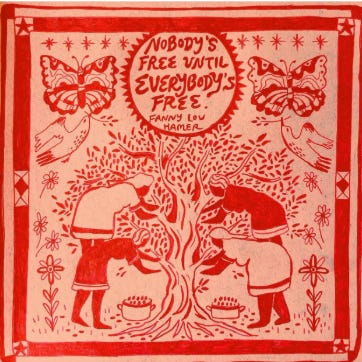
Image Credit: @windsorkincade on Instagram
Some of our favorites
Julie: I’m attached to a few pieces where we’ve worked to lay out what a specifically New York kind of resistance could or should look like. We’ve talked about our J-walking, fuck you, don’t tell me what to do attitude, about our immigrant-welcoming Statue of Liberty, about how we treasure anonymity but will gladly talk to, help, or yell at a stranger on the street as if we’ve known them for years. And of course we are completely smitten with the polka-dot dress lady, who gave us all a hero to look up to and emulate.
Relatedly, I’ve also liked drawing on some of the city encounters I’ve had, with my local Orthodox grocer or the Egyptian halal cart guy (with Cheryl P) to illustrate what it can look like when we take our beliefs, and our messages, out into the world.
I’m proud that we’ve managed to ship a new roundup week after week, even when it’s Thursday evening and we still haven’t added anything to the Amplify list and are scrambling to edit each others’ writing and find images to sprinkle throughout. (OK, not gonna lie, it’s usually Kate who does the heavy lifting on that last part). And I’m grateful for the chance to pause each week and try to make sense, for ourselves and hopefully for others, of what we’re living through and how best to respond to this extreme moment, so devastating but also full of promise.
Kate: Writer Sally Rooney recently spoke about how the cost of Palestinian solidarity is often what gets emphasized in public discourse, and what gets left out is the honor and privilege it is to have any sort of public platform to stand with the people of Palestine. And so, from our small corner, I am proud of the times we joined in that advocacy. Speaking out against the genocide in Gaza and for Palestinian rights means so much to me because it is core to my sense of justice, shaping the ways I see and act, whether that’s patrolling for ICE or calling out harmful lies. I guess you could say writing about Palestinian justice in community with Julie, our guest writers, and readers has made me feel more whole, connected, and determined to fight for all of our collective liberation.
I also love that our newsletter ranges from dense, historical and serious to light and irreverent. In the former category, I’d say that our piece on hypernormalization stands out. It felt relevant to what a lot of us had/have been feeling: How can people just go on with their lives in the midst of this authoritarianism? That edition touched upon Fraenkel’s notion of the dual state, Tolentino’s notion of a broken brain, Foucault’s panopticon, Huxley vs. Orwell, Marantz’s phases of authoritarianism, King’s “creative maladjustment,”and the movie The Zone of Interest, and I think still managed to make sense. Then we have the cursing, irreverent memes and other visuals that infuse our newsletters with a different sort of life. We also managed to reclaim the term “Piggy” after Trump tried to use it as a tired, sexist insults on a female reporter, once in a story about my playing the eponymous character while teaching Lord of the Flies, and again in the homage to the fabulous and fierce Miss Piggy, aka Ms. Piggy.
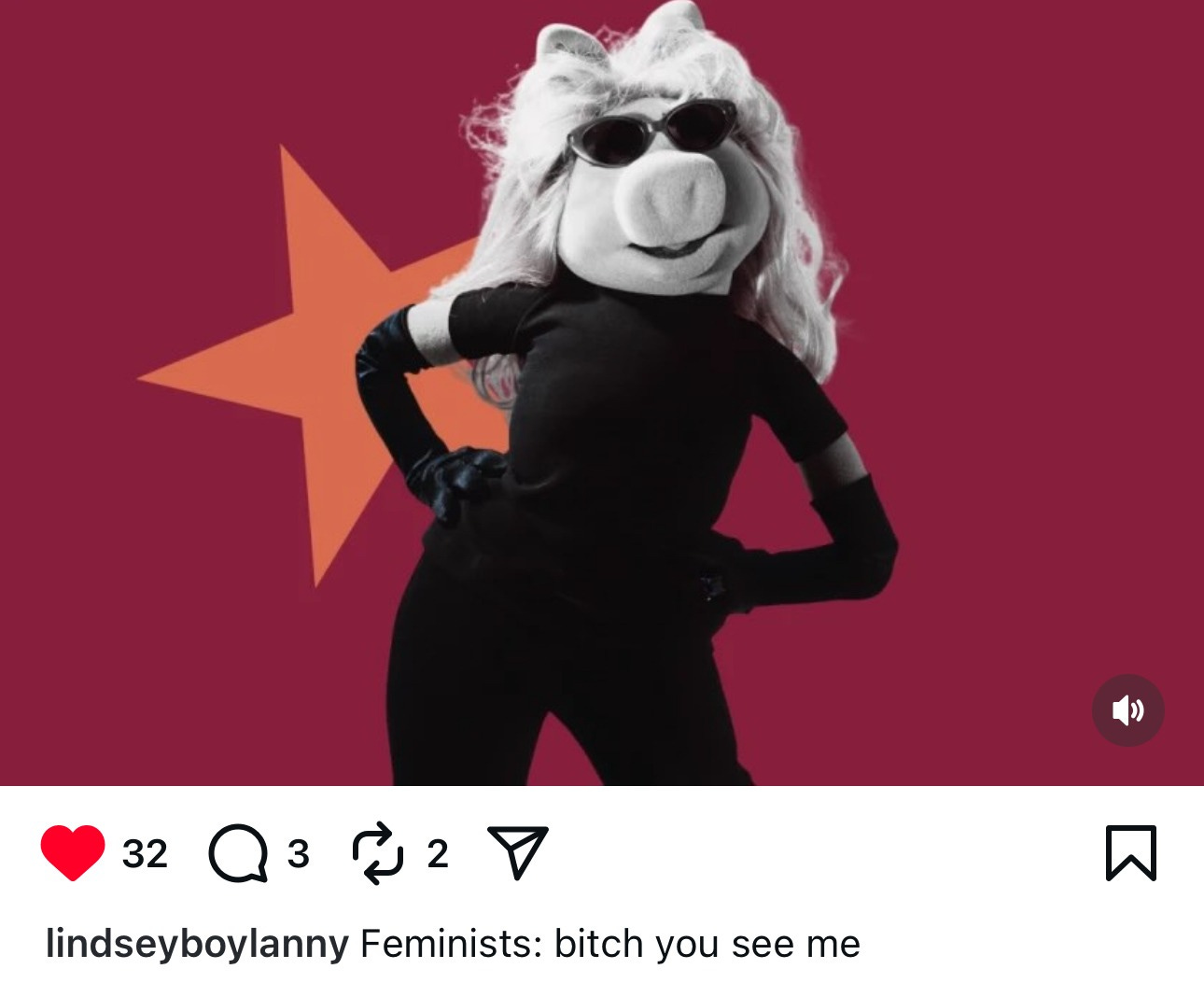
From the 11.21 Roundup: from Community Building to Miss Piggy, Image Credit: Lindsey Boylan on Instagram
We’d love to hear your favorites, so feel free to drop us a line about what has resonated with you.
Amplify this
Neighborism and overcoming learned political helplessness in St. Petersburg (Russia)
A dark and killing cloud over Tehran, Bill McKibben
What does “woke” really mean? This guy gets it.
Why you should be inviting everyone you know to NK3 (by Micah Sifry) with a shoutout to BKR
Timeline cleanse: Tiny Desk Concerts, Delaware supermarket edition (h/t Mikki)
Rebecca Solnit in the NYT
What to Do with Our Rage, from We Can Do Hard Things podcast
Help send Brad Lander to Congress! Volunteer opportunities here.
Meet the likely new prime minister of Nepal, a young mayor, rapper and fighter for social justice. Sound familiar?
And as always,
‘Til Next Time,
Julie, Kate & the Messaging Team
 | A guest post by
|
 | A guest post by
|