Messaging Roundup: Cycling between grief and action in the face of state-sanctioned violence
Kate visits the Renee Good memorial in Minneapolis, and Julie participates in a parking lot protest in Tribeca


Hi Resisters,
We’re back!
We want to begin by thanking Mandy Keifetz aka Minty Chaffeuse for her inaugural Crucible Questions column last week. We love how Mandy combines her unique style with her activism savvy in the form of practical advice for our readers. Send her your burning questions for Minty using this form!
Today, as we witness the beginnings of an anticipated and feared ICE surge in our beautiful, immigrant-filled city, we explore two vital responses to this moment: grief and action.
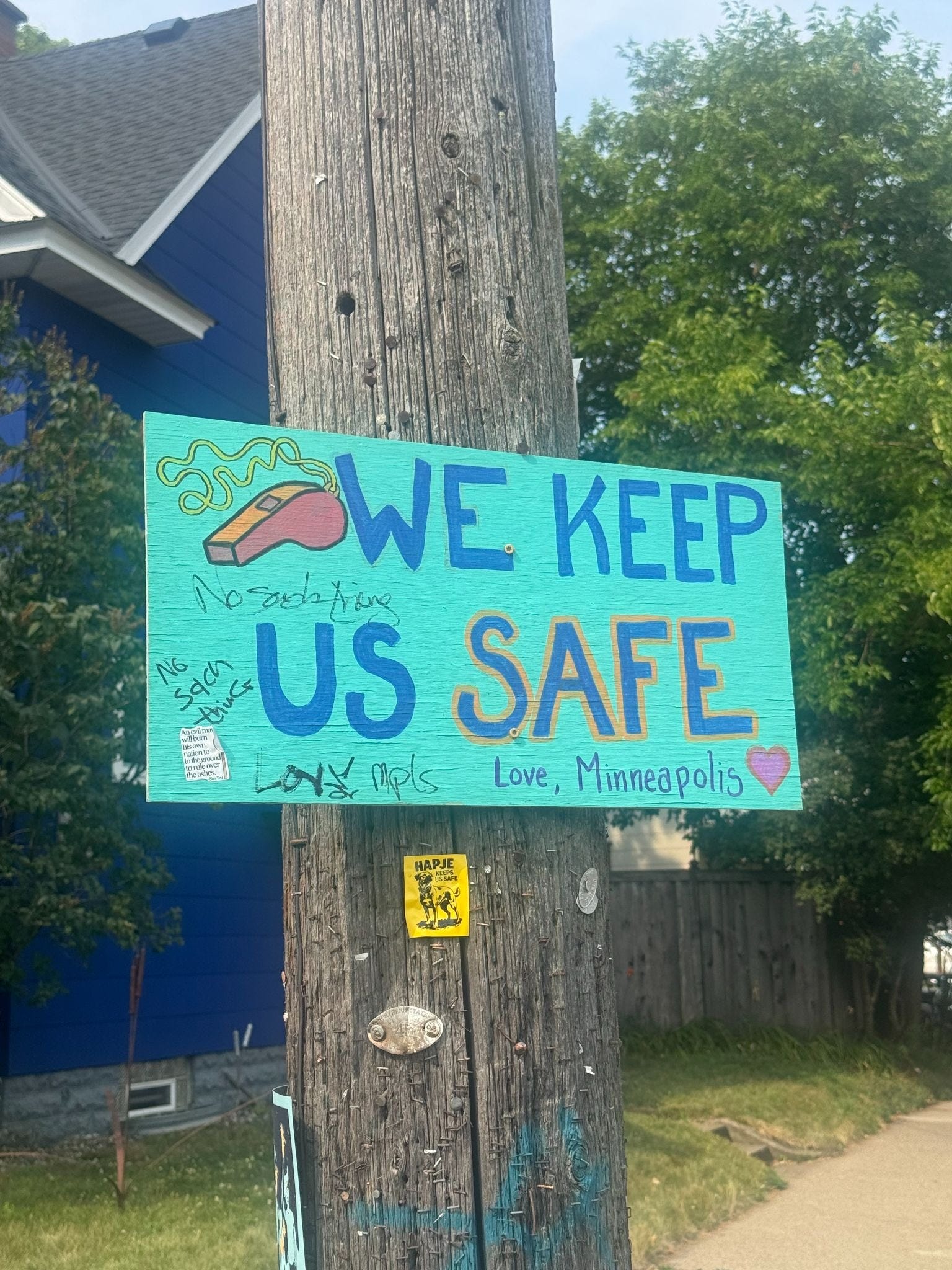
Sign in Minneapolis not far from the Renee Good memorial. Photo credit: Kate Dalton
Remembering Who and What We’ve Lost
By Kate Dalton
Dear Renee,
We miss you <3
-Minneapolis
This was what was written on one of the many handwritten notes left on the side of a street in South Minneapolis, the site where Renee Good was murdered. I was in town for a family visit, and hadn’t expected I’d have time to visit the memorial, but just a few hours after landing, there I was, surrounded by love, grief and anger. One printed sign read, “MN>ICE” and another said, “We Fall/We Break/We Fail/We Overcome” next to a list of names of those murdered in the city, including George Floyd. In the middle of a large arrangement of flowers and Pride flags was a poster that read “Good people bring out the good in people.” Another handwritten sign said, “We will carry on your fight against the fascist regime,” the tassel of a keffiyeh draping slightly over it. On the fence of the adjacent yard were pictures of Renee Good, Alex Pretti, and other individuals killed by ICE. At the far end in a space all by itself were two simple black and white signs with the quotes “I’m not mad at you” and “Are you OK?”—the last words of Renee Good and Alex Pretti respectively.
There were also words and illustrations from a local Native American tribe, reminding me of how Ojibwe jingle dress dancers visited the death sites of Good and Pretti to perform healing rituals. The poignancy of that community response came back to me, and I was again struck by the gesture of a people who have known sorrow, loss, and injustice on a scale that’s difficult to comprehend.
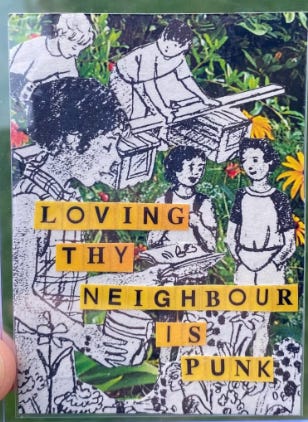
Image Credit: @punkrockfleamarkethamilton
Like much of the memorial, there were layers to the grief. It wasn’t a carefully designed space like many of the monuments we’re accustomed to seeing. The site had clearly been created with intention, and there were signs to guide, like the one requesting that people not post images of the memorial on social media. But there were no neat borders between the various causes and victims represented there. In that way it felt more authentic and reflective of the interconnectedness of our various struggles and grief itself, which has little respect for our lines no matter how hard we may try to draw them.
Twenty minutes later, as we drove away, I felt this messiness of grief as I found myself breaking down in tears. I was overwhelmed by the loss captured by the memorial, as well as the kindness. Here was a space for people to gather and pay tribute to Renee Good and the values she stood for. It was also a place to acknowledge and honor the many victims of state violence, especially nonwhite people. Overall, I found it to be both devastating and beautiful. But I wasn’t just grieving these victims. I was also grieving the loss we have all been experiencing as we see the erosion of democracy, the disappearance of our neighbors and due process, and an overall absence of humanity on the national and international stage. I couldn’t help but remember when I went out on an ICE watch the day after Renee’s death and how Julie and I faced off against an ICE van carrying a detainee at Delaney Hall. My involvement pales in comparison to others involved in rapid response, but I sat there crying, thinking that it’s all been just too much—for me, for anyone. The site visit had jolted a flood of memories and emotions that ended up putting the last year in perspective. It wasn’t the kind of perspective that downplays events but rather it was the kind that puts a spotlight on them. It is all indeed too much, but the memorial reminded me that we can carve out spaces for our grief and for our indomitable spirits. Like the sign said, “We fall/We Break/We Fail/We Overcome.”
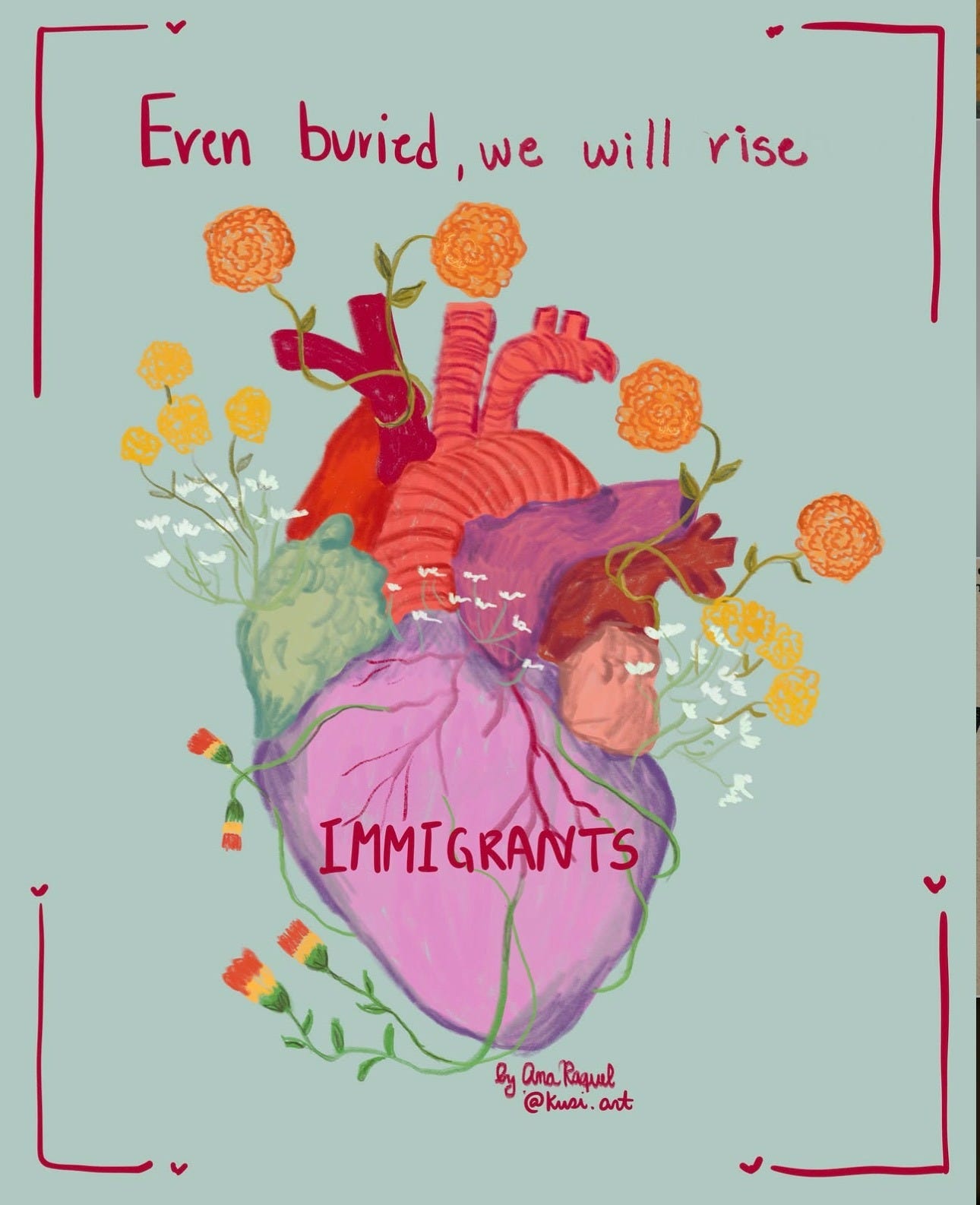
Image Credit @kusi.art and @art.anaraquel
Finding Purpose and Power in a Targeted Action
By Julie Subrin
Last weekend, Edwin Lopez-Cornejo, a 39-year-old man, died while in detention in Delaney Hall, leaving behind a 12-year-old daughter, and many others who loved him. His death seems to be a clear case of medical neglect. When he was abducted in June, he had been on medication for diabetes, high blood pressure and seizures. The day before he died, he had complained that he wasn’t feeling well and that part of his face and his right hand had gone numb. Medical staff did not take immediate action, and by the time he arrived at the hospital, his heart had stopped.
Unfortunately, Lopez-Cornejo’s death is part of a larger pattern. According to CNN, over 50 people have died in ICE detention since Trump returned to office. What’s more, “more detainees died in custody in 2025 than in any year in at least two decades, and 2026 is on track to be even higher.”
No one deserves to die for crossing a border in the hope of making a better life for themselves and their families. As Lopez-Cornejo’s young daughter put it at a press conference on Tuesday, “No one here is illegal. [...] Everyone here should feel welcomed, not seen as criminals.”
You know who should be seen as criminals? The architects and enforcers of Trump’s mass deportation project, and the people profiting from it. Monday evening, a few of us called out these ICE-enabling profiteers by joining an action organized by Hands Off NYC, Rise and Resist, and other groups.
I’ll be honest: I don’t really like going to protests. I’m prone to sensory overload, and something in my DNA revolts against shouting things in unison. Maybe it’s a fear of mobs. (My Pale of Settlement Russian-Jewish ancestors definitely had reason to fear mobs, in the form of marauding Cossacks, and I suppose that flight/freeze response lives on in me.)
Still, like many of you, I go to protests somewhat regularly these days, if only to be an additional body added to the count. The experience can range from moving and powerful to meh, or, at worst, dispiriting.
The protest Léa, Cheryl and I joined in Tribeca felt genuinely satisfying. This one had a clearly defined purpose: to call out enablers right here in our city making a profit off of ICE operations. Specifically, we were gathered down the block from an ICON parking garage on Harrison Street that contracts with the federal government. Recently, activists learned that a fleet of brand new, unlicensed SUVs—precisely the type of vehicle used for ICE operations—had taken up residence there. Given all the signs we’re getting that ICE is about to launch, or is already slow-launching, a surge of abductions here in NYC, exposing and hopefully undermining this kind of collaboration is absolutely essential.
And so we held up signs with clear, targeted messages: “ICON collaborates with ICE.” “NO PARKING for ICE anytime anywhere!” The crowd was not huge, maybe 100 of us in total, but it felt energized and purposeful. There were only a few short speeches, during which speakers laid out clearly why we were there, who we were targeting, and what the ask was: that the owners of this parking facility stop giving cover to ICE. Organizers gave out handouts with phone numbers and instructions on how to deliver that message.
And then there were the chants, meant to loudly shame ICON and to catch the attention of local residents: “ICE out of Tribeca!” and “Hey ICON, you can’t hide, we know you have ICE inside!” A chant like “Hey hey, ho ho, fascism has got to go” always feels a little empty to me. But I genuinely wanted to shout at ICON, and to wake up the neighborhood to the fact that an ICE staging ground was right here at their doorstep.
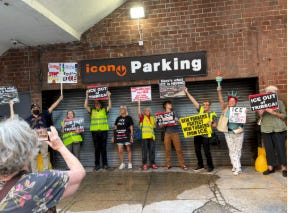
ICE out protest, Tribeca, Aug. 3. Photo credit: Julie Subrin
Maybe a dozen cops were there, but they didn’t interfere. City councilmember Christopher Marte spoke eloquently about this local, pressing need for us to protect our neighbors. At the end, we all marched to the garage entrance where the fleet is said to be parked. (A few days after the fleet was first identified, the entrance was covered up so the public could no longer see inside, but not before activists documented the line of cars.) We chanted some more, and there was a banner drop. And then we called it a day, and went and got some lemonade. The whole thing was decently covered by NY1 and social media, which we took to be a mark of success.
This protest was organized by Hands Off NYC, Rise and Resist, and other local Hands Off neighborhood satellites. Similar local coalitions have successfully campaigned to get other entities to cancel contracts with ICE. I think we can all learn from their spirited, targeted, call-to-action driven approach. I will gladly go back and help them make some noise, in Tribeca and wherever else this inhumane deportation machine attempts to set up their operations.

Image Credit: @mainanddevine
Amplify this:
A great conversation between Abdul El-Sayed and Anand Giridharadas, along with Anand’s thoughts on what makes El-Sayed such a good, interesting candidate
New York Can Do Anything, Including Single-Payer Universal Healthcare, from the Indypendent
Tuesday was a good day for those who believe in protecting and expanding abortion rights in the US.
Historian Erin Maglaque discusses her new book ‘Presence: A Hidden History of the Female Body’ from The LA Review of Books podcast.
Signs for Troubled Times (h/t Isabel)
Ta-Nehisi Coates on how “we overrate intellect and we underrate wisdom” and how the fight against genocide is connected to the fight against fascism
Did you see Trump’s trophy? (h/t Léa)
Robby Hoffman is repping for the MTA
A short history of tenant organizing in NYC, from the Mayor’s office (h/t Eliana)
Climate change isn’t a tragedy. It’s a crime. And to Rebecca Solnit, it’s a war zone.
Check out this deportation calculator. How much is your county spending? (h/t Amy S)
And as always,
‘Til Next Time,
Kate, Julie, & the Messaging Team
 | A guest post by
|
 | A guest post by
|